I’ve always wondered how DEWKs (Dually Employed With Kids) manage to squeeze time between work and, well… survival. Even back when I was employed, I couldn’t imagine my stay-at-home wife ever finding time to work given the circus we run at home.
We have a 10-month-old who is almost definitely the reincarnation of a Filipino call center agent who actively volunteers to work the night shift for that juicy extra pay. Top that up with a four-year-old who started school this year, which means we need to wake up at 7 a.m. at the latest. But despite all the playing he does at school, he somehow returns home with enough energy to plow through our living room like a Category 4 toddler. My wife is out of energy before the day even begins.
Luckily, I used to work from home, so I could help with the chaos. I’m mainly in charge of the fournado and cooking meals. When the BPO baby is with me, my wife takes a nap. When she wakes up, I melt into the couch. It’s a perfectly timed relay of tired parents. A harmonious system.
So the question returns: How do DEWKs do this?
The obvious answer: grandparents. Last week I dropped my son off at school and met the guardian of his close friend. Surprise, surprise, it’s a grandparent. But we’re immigrants. Our parents are back in the Philippines and aren’t exactly excited about a 24-hour flight just to become unpaid childcare again.
So daycare? Not for now. We’re stretching my savings until I land a new job.
If we can’t reduce the workload, we can at least reduce the stress. And to do that, we decided to play the hand we were dealt using Agile.
I know Agile Processes are probably one of the leading causes of stress for engineers. Your manager’s approach can make or break a team’s groove. Am I biased since I like process improvements? Probably. Actually… yes. But that is why it’s called “improvement.” The goal is not to obey the process; it’s to make life better.
So why did I decide to “project manage” my wife?
Household work is probably the most time-consuming part of life outside employment, yet somehow the least planned. Laundry piles up. Leaves pile up. Snow piles up. Appointments appear out of nowhere. Something needs cleaning every five minutes. And then, for added spice, the fournado brings home a flu.
My wife thought to herself, “I’m gonna make a to do list. That should help me be more organized”. It didn’t. It became another endless pile that stressed her out.
We then tried a fixed daily schedule.
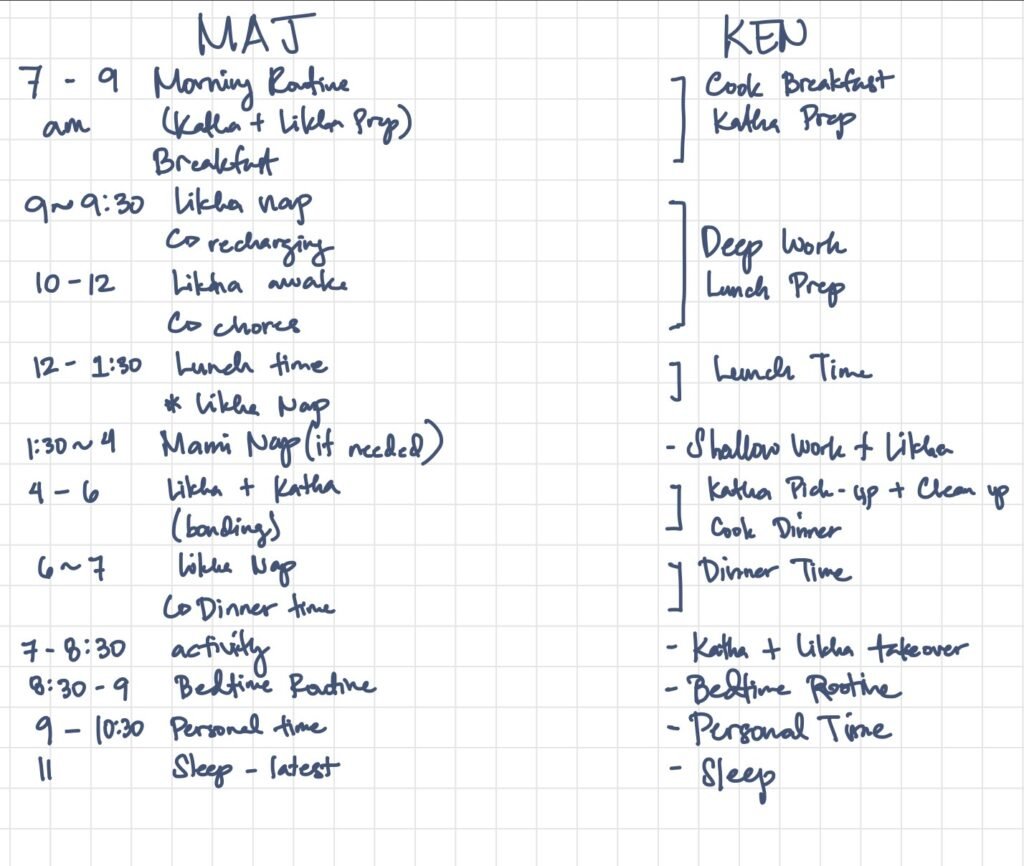
You’ll notice that I have the most time for work since I’m actively job hunting and upskilling. On paper, it looked logical. In reality, it broke down as soon as life threw even a pebble into the system. When my wife joined me to build mithi.io, she took on the product designer role. She used to work in fashion and has strong graphic design skills. She needed focus time and rest time, which meant I needed to sacrifice some of my planned work time. Doctor appointments also didn’t care about our beautifully crafted schedule.
That’s when I introduced Agile at home.
Our Home Scrumban System
I built a workspace in Notion and “encouraged” my wife to install the app across all our devices. We follow a Scrumban approach. Scrum’s focus without the rigidity, Kanban’s flexibility without the chaos. Perfect for balancing a household and a creative project. Our workspace has five views:
1. Board View – For the day-to-day tasks.
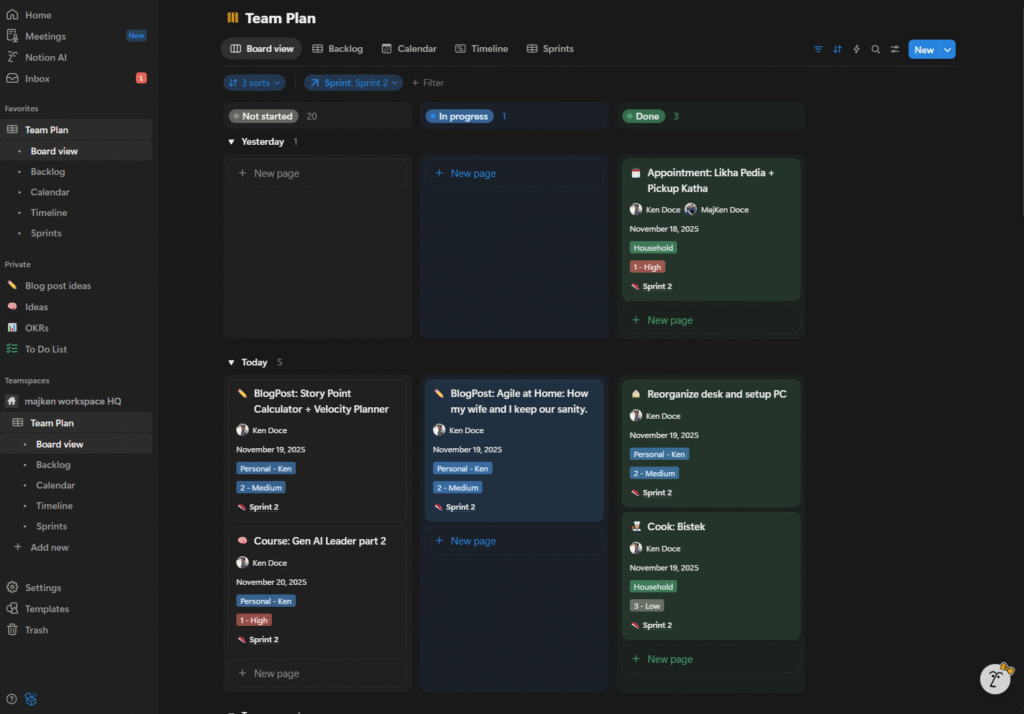
2. Backlog – Where ideas and tasks land before planning.
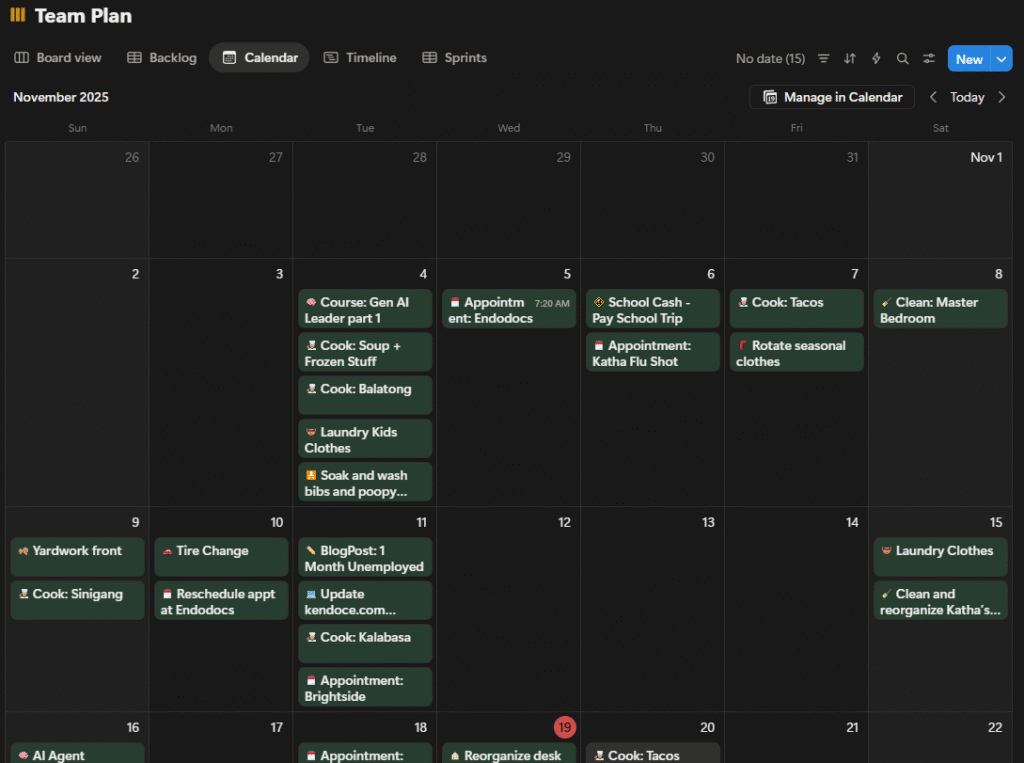
3. Calendar – Tasks with fixed dates (doctor visits, school events).
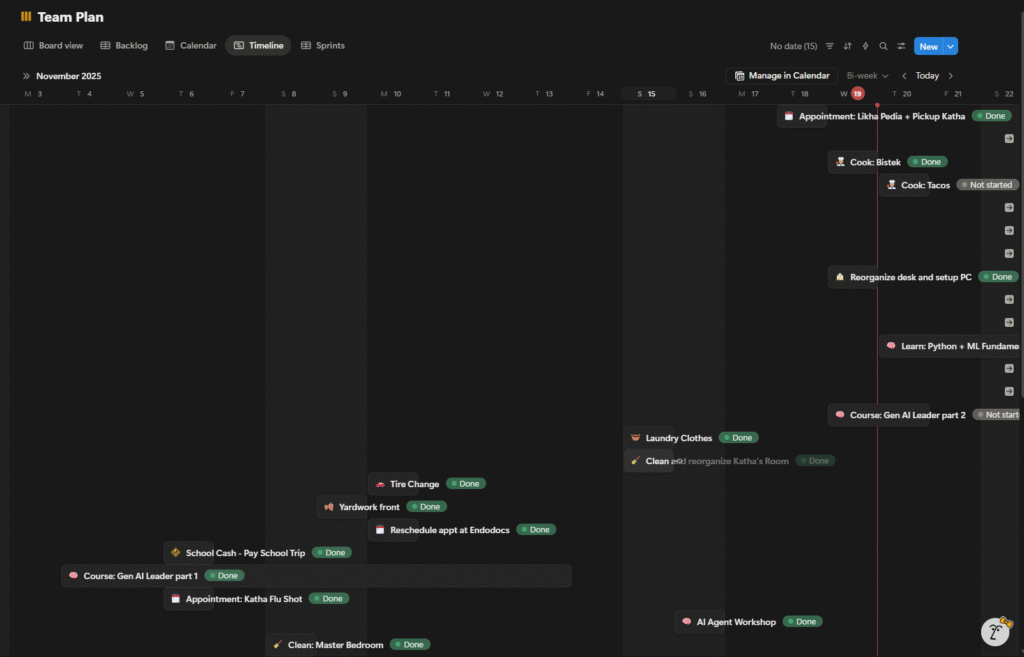
4. Timeline – To visualize task length and dependencies.
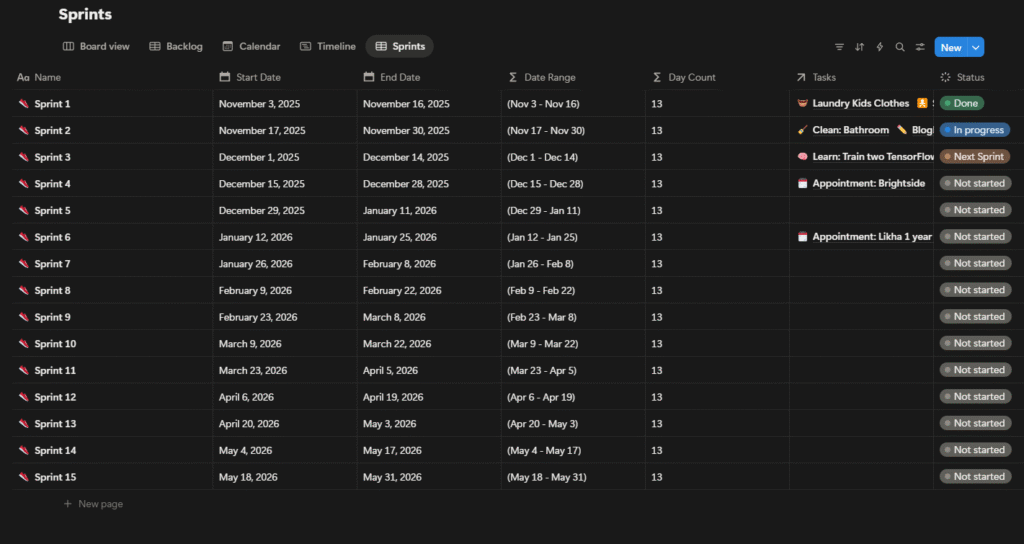
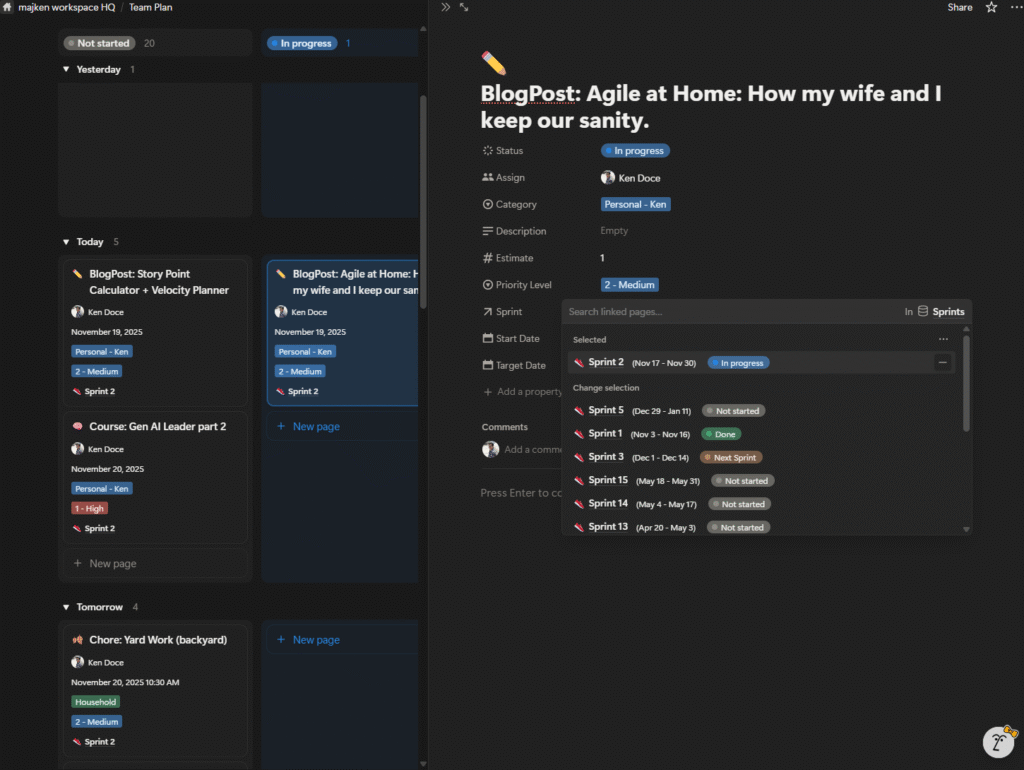
5. Sprints – A simple database showing sprint date ranges and status. Though the cards don’t show the date range, they are visible when selecting a sprint from within the card.
What we track
We don’t track everything. Some things will happen whether we like it or not:
Baby care
Bedtime routine
Washing dishes
…taking a dump, unless you’re gone for an hour – then maybe that’s an epic.
These don’t need cards. They don’t require planning or coordination. We track only the tasks that change something: mithi.io work, design reviews, content creation, errands, meal planning, home improvements. Anything that needs ownership and timing.
Sprint Ceremonies
We only run two: Planning and Daily Standup.
How did I convince my wife to do this? I’m still confused myself. 😅
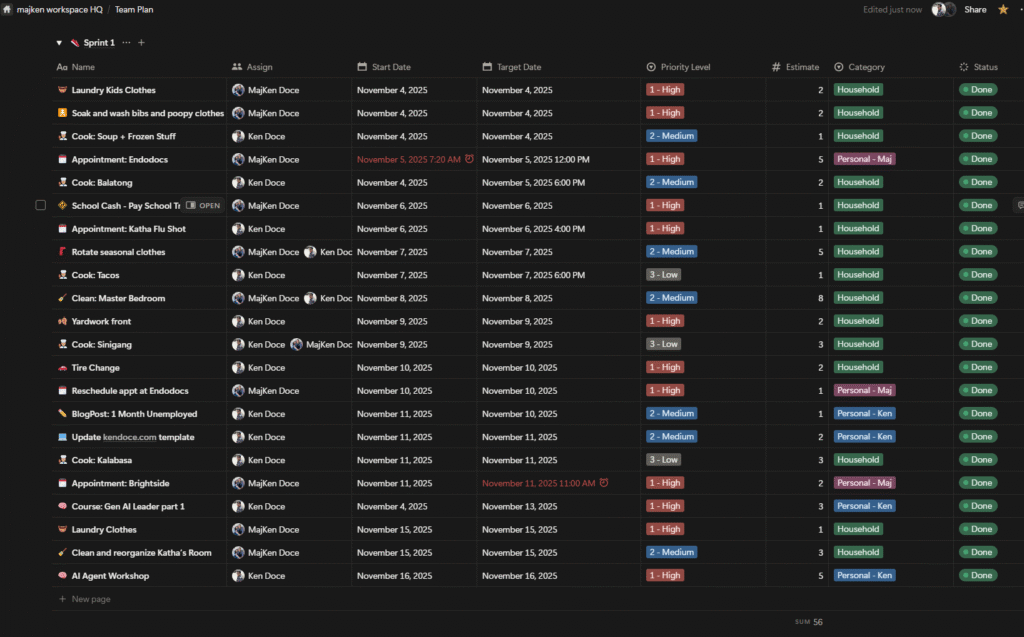
Planning: We pick the tasks we want to intentionally focus on for the next two weeks. We assign properties: assignee, category, sprint, priority, dates. Then we estimate using my Story Point Calculator and compare against our velocity.
Sprint 1 was our benchmark. We planned 65 points. If you revisit the image in the Backlog view above, you’ll notice that we delivered 56.
Now in Sprint 2, we committed to only 50 to give ourselves breathing room.
Daily Standup: Every morning after I get back from the bus stop, we check our tasks for the day and discuss:
Who needs focus time?
Who handles the baby?
No guessing. No overthinking.
The board becomes a mirror of our intentions — not our routines. It shows the work that moves our life and our app forward.
Benefits that we’ve seen so far
1. Less mental load
My wife’s old to-do list felt endless. Seeing a pile of laundry used to trigger stress. Now? If it’s not in the sprint, it’s not today’s problem.
2. Clearer communication about time
Before, my wife always sacrificed her creative time because I was the “breadwinner.” But this season is different. Now we can make deliberate trade-offs so she gets time to create.
3. One source of truth
Before Scrumban, events were scattered: Google Calendar, fridge calendar, iPad GoodNotes, and sometimes there are events/appointments that are buried in Facebook Messenger. Now everything lives in Notion. Less chaos, fewer surprises.
So… Did It Work?
In a way, building our little system wasn’t about productivity at all. It was about reclaiming a bit of mental breathing room in a season where everything feels loud and unplanned. It gave us space to rest without guilt, create without scrambling, and handle curveballs without immediately spiraling into chaos.
Our house is still messy sometimes. The fournado still ricochets around the living room. The BPO baby still prefers graveyard shifts. But now, instead of drowning in all of it, we’re steering the ship together. Intentionally, calmly, and with a shared sense of “we’ve got this.”
Maybe that’s the funny thing about applying Agile at home. You start out thinking it’ll help manage chores, but what it really manages is your sanity. And in this season of life, that feels like the most valuable deliverable we’ve shipped so far.
If you’ve hacked your way through household chaos, I want to hear about it. We’re all trying to level up.